What history can still teach us about work today
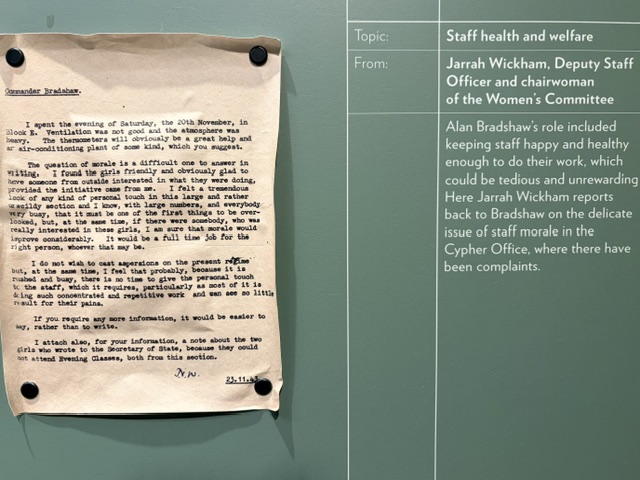
I recently read an internal memo about the conditions in an organisation I was visiting. It described a department with…


During a recent session I asked a group of NHS managers and team leaders a simple question: what gives you a sense of purpose at work?
One nurse – I’ll call her Amara – shared one of the most powerful stories I’ve heard in my career. She talked about her childhood and about a decision made in her family – one that cost the people who made it, and shaped the lives of more than just her. The silence in the room was deafening and by the end, she, and most of the rest of us, were emotional.
That moment has come back to my mind on an almost daily basis since, not just because it was moving, but because of what it showed about her relationship with her work. The pressures she faces on a daily basis haven’t changed and the job is still hard but she knows exactly why she does what she does and that turns out to matter more than almost anything else we measure.
I’ve worked with hundreds of managers, and I’d guess most of them have never once asked the people they lead that question. It certainly isn’t something I was ever asked as an employee.
We ask about objectives. We ask about development needs. We do appraisals and one-to-ones but we almost never ask the thing sitting underneath all of it: why are you really here?
People care about this more than many of us realise. Deloitte’s most recent survey of younger workers found nearly nine in ten say a sense of purpose matters to their job satisfaction, whilst more than 40% say their work is central to who they are – second only to friends and family.
There’s a great research on this from Amy Wrzesniewski at Yale. She found that people relate to their work in one of three ways. Some see it as a job – a means to an end, the thing that funds the life they actually care about. Some see it as a career – somewhere to climb, to build status. And some see it as a calling, where the work is bound up with who they are and why they’re here.
The categories aren’t the point. The point is that people with a calling are motivated by the work itself, drawing deep satisfaction from the difference they make and often seeing the work as an expression of their values. It’s a different relationship altogether.
Purpose at that depth doesn’t behave like the things we usually pull on to motivate people. It isn’t a target or a bonus or a set of values on the wall. It started long before the job – for some people, long before they could have chosen it.
The psychologist Dan McAdams has spent a career on this. His argument is that we are partly the stories we tell about ourselves – where we came from, what happened to us, what we think it was all for. For some people, their work is a chapter in that story and it carries the weight of everything that came before it. When Amara talked about her childhood and then about her job, she wasn’t changing the subject. It was one thread. That’s not motivation. It’s identity.
If you’re a leader, there’s an obvious worry here. You can’t give someone a reason to care, nor can you manufacture a calling.
This is where Adam Grant’s work is useful. He ran a study with workers in a university fundraising call centre – cold-calling alumni for donations, the kind of repetitive work with a lot of rejection built into it. He arranged for them to spend time with a student whose scholarship their calls had paid for. Afterwards their effort increased by 142% and their fundraising rose by 400%, and stayed up. Nothing about the job had changed. They could just see who it was for and the impact it had on their lives.
It’s worth remembering that people don’t all join us with a fully formed sense of purpose, but almost everyone responds to seeing the difference they make. You don’t have to generate meaning out of nothing, it’s often already there, and the job is to connect people back to it – to close the gap between what they do and who it’s for. It’s the same instinct underpinning self-determination theory: people are at their best when they feel some ownership of their work and some sense that it matters to someone. Most of us are starved of the second one, not because it isn’t true, but because nobody ever helps connect us to it.
I want to be careful here, because it’s easy to take this too far. Purpose is not armour. The people with the deepest sense of why they’re there are often the ones who take on too much, stay too long, and say the least when they’re struggling – because the work means so much that admitting it’s costing them feels like letting it down. Meaning can carry someone through a hard stretch. It can also be the reason they don’t tell you they’re drowning. A sense of purpose doesn’t reduce your duty to look after people. It raises it.
I keep coming back to that room, to Amara, and the quiet after she finished. We spend so much effort trying to motivate people. Incentives, frameworks, the whole apparatus. Yet most of the time the thing that actually moves them is already there, formed long before they met us.
Further reading
If you want to dig into the research behind this, these are worth a look:
Amy Wrzesniewski et al., “Jobs, Careers, and Callings” – the original research on how people orient to their work https://works.swarthmore.edu/fac-psychology/193/
Adam Grant’s field experiments on task significance – including the fundraiser and scholarship studies https://selfdeterminationtheory.org/SDT/documents/2008_Grant_JAP_TaskSignificance.pdf
Dan McAdams on narrative identity – the stories we build our lives around Narrative Identity – Dan P. McAdams, Kate C. McLean, 2013
Deloitte’s Gen Z and Millennial Survey – on purpose, identity, and what younger workers want from work https://www.deloitte.com/us/en/insights/topics/talent/2025-gen-z-millennial-survey.html
Hill & Turiano (2014), Psychological Science – purpose in life linked to longevity across adulthood https://www.sciencedaily.com/releases/2014/05/140512124308.htm